Name of Source
|
Hyperlink
|
What
information was used
|
What post I used it on
|
(WEBSITE)
Wikipedia
|
https://en.wikipedia.org/wiki/Opening_credits
|
Common opening credits order
|
Extensive research on jobs appearing in credits
|
(WEBSITE)
Wikipedia
|
https://en.wikipedia.org/wiki/Opening_credits
|
History of opening credits
|
Opening credits research
|
(WEBSITE)
New England Film
|
http://newenglandfilm.com/magazine/2012/08/credits
|
How and why opening credits are used
|
Opening credits research
|
(WEBSITE)
Wikipedia
|
https://en.wikipedia.org/wiki/Thriller_(genre)
|
Themes and characters
|
Codes and conventions of the thriller genre in
film.
|
(PDF) Correspondence
analysis of genre
preferences in UK film
audiences
|
http://www.participations.org/Volume%209/Issue%202/4%20Redfern.pdf
|
Cross-tabulation of interactively-coded
gender-age variable with genre
|
Relationship Between Age, Gender, and Genre:
SECONDARY RESEARCH
|
(WEBSITE)
Wikipedia
|
https://en.wikipedia.org/wiki/Alfred_Hitchcock
|
Main page information
|
Alfred Hitchcock - Suspense and Thriller
|
(WEBSITE)
Wikipedia
|
http://www.bbfc.co.uk/
|
12A/12 and 15 information
|
The BBFC Certificate of Our Film
|
(WEBSITE)
Twyman-Whitney
|
http://www.twyman-whitney.com/film/essentials/music-history.html
|
History of film scores
|
The History/Elements of Film Scores
|
(WEBSITE)
Wikipedia
|
https://en.wikipedia.org/wiki/Film_score
|
Elements of a film score
|
The History/Elements of Film Scores
|
(WEBSITE)
Scaruffi
|
http://www.scaruffi.com/history/film.html
|
First rock song appearing in film
|
The History/Elements of Film Scores
|
Showing posts with label RESEARCH AND PLANNING. Show all posts
Showing posts with label RESEARCH AND PLANNING. Show all posts
Friday, 8 April 2016
Bibliography for Research and Planning

Sunday, 6 March 2016
Lighting, Editing and Sound - Research
Lighting:
- HIGH KEY - The lighting is bright and may include mixed white colours. We won't be using this lighting because we can't to create a somewhat unsettling atmosphere for the audience.
- LOW KEY - This lighting is dark and may include shadows and dark tones. We might be using this lighting because it will create a dark vibe, but we don't want our sequence to come off as a horror so we might opt for something else.
- COLOUR FX - Different colour combinations depending on the atmosphere of the film. Examples are black and white or sepia, as well as blueish effects or warm yellow effects. We might use this lighting as opposed to the low key lighting. This is because we can make the sequence dark and creepy but not too scary so it can be seen as a thriller and cause suspense.
In this video I have used an effect from iMovie called 'Day to Night', which includes bluish but dark tones and makes the lighting low key.
EDITING:
- CONTINUITY EDITING - Film sequences normally follow this type of editing in order to make them flow and transition in a believable way. Only cuts will be used in order to make scenes more realistic.'Cross-cutting' may also be included, which is when two different pieces of action are shown at the same time during a sequence, but it still maintains a flow to make it have a 'real life' affect. This is the main common editing style in film, so we will be using it in our opening sequence, however we may add some fades in and out of the sequence to create more variation.
- MONTAGE EDITING - The opposite of continuity editing, whereby the cuts in the sequence are noticeable and don't have a flow of time.
- CUT - An image is instantly replaced by another without a noticeable transition. We will be using this because it is used in continuity editing.
- CROSS/DISSOLVE - One image dissolves into another.
- FADE UP - An image fades in from black. We will be using this to transition from the quote to the start of the scene.
- FADE OUT - An image fading out to black. We may use this after the title of the film is shown.
- WIPE - One image replaces another and the border between the image will move across the screen.
SOUND:
- DIEGETIC SOUND - Sound that is involved and is part of the film world e.g. cars or birds. We will be using this for our phone sound effects.
- NON-DIEGETIC SOUND - Sound that is not part of the film world and is not part of what is happening on screen e.g. a soundtrack. We will be using a soundtrack in our opening sequence.
- SOUND BRIDGE - Linking two scenes together through sound. We may use this in our task.
- SOUND EFFECTS - Sound which is added on which is not dialogue or music. Sound is added during post-production e.g. our phone ringing sound effects.
Friday, 26 February 2016
Psycho Film Scored Analysis
This is one of the most popular pieces of film score music. It was composed by Bernard Herrmann and is the theme for the film Psycho, by Alfred Hitchcock. It could be argues that the Psycho theme is Herrmann's best and most admired film score. It was created on a low budget and so only involves string instruments, which happen to suit the genre of a horror/thriller. Herrmann had the idea that the string instruments to reflect the black and white cinematography. The theme is played in the very beginning of the film with the opening credits, as well as appearing in other intense parts of the film (the infamous shower scene). The fact that the score is just string instruments and it is a somewhat small instrumental ensemble creates tension for the audience because of the fact that it is quite fast paced and the volume of the instruments often change with sharp jabs of violin to shock the audience.
The score has influenced many other pieces, including one adaptation of the score by Danny Elfman, which was actually made for the 1998 remake of the film. Elfman is a famous composer and song-writer and has worked with people such as Tim Burton. There are other scores that have been influenced by Psycho, which have copied it's use of sharp jab sounds to create suspense.
The theme plays in the opening credits, however nothing dramatic actually happens for the first 15-20 minutes of the film, which created the affect of the audience being on edge because the theme would be stuck in their heads whilst they are watching the first few scenes.
I will be finding a score for out opening sequence, which created tension for our audience. Psycho is a horror/thriller, however out film won't include many elements of a horror. Therefore, the piece that we end up using may be a bit slower paced than this score. We want it to have a dark tone and be a bit unsettling so that the audience know that there is something wrong and they can be on edge whilst watching.
Thursday, 25 February 2016
The History/Elements of Film Scores
The History of Music in Film
Before the 1930s all movies were silent. Music was commonly included in theatre productions and was brought to films to add some depth to the images shown on the screen for the audience as well as for tradition.
The majority of silent films were accompanies by full orchestras, organists, and pianists. Various books of music were published to provide ideas for scene music to have an affect on mood, element, or event.
During the 1930s, music was established as a vital element within film. Sound within films was usually Western Classical Music (from the 19th century) would play over the film. However, original scores started to become a normal thing.Mas Steiner was the first to write a completely original score for King Kong (1933). Composers began to develop their own styles of supporting film.
In the 1940s, composers began to evolve in their work, and one of the most important and influential composers was Bernard Hermann (who I have mentioned on a previous post). He was able to create music to enhance the films that they were made for.
Jazz music had become common in the industry from the 1950s. It required less musicians, so orchestration was less expensive. James Myers and Max Freedman wrote the first rock song to appear in a film (1953), as the use of different genres was experimented with. The 1960s and 1970s included perfecting previously learned techniques and uses and also a few highly memorable scores.
The first widespread use of synthesized sound took place in the 1980s, which stemmed a film score revolution which made it a more popular choice. it became possible to score a whole film with only one performer for the very first time, using a synthesizer to product the sounds of various instruments. This caused popular songs to be produced and used as film scores.
Today, with the ongoing development of new technology and knowledge, film composers have the ability to create the perfect film score. This enhances the film and transforms it into an experience for the audience.
The majority of silent films were accompanies by full orchestras, organists, and pianists. Various books of music were published to provide ideas for scene music to have an affect on mood, element, or event.
During the 1930s, music was established as a vital element within film. Sound within films was usually Western Classical Music (from the 19th century) would play over the film. However, original scores started to become a normal thing.Mas Steiner was the first to write a completely original score for King Kong (1933). Composers began to develop their own styles of supporting film.
In the 1940s, composers began to evolve in their work, and one of the most important and influential composers was Bernard Hermann (who I have mentioned on a previous post). He was able to create music to enhance the films that they were made for.
Jazz music had become common in the industry from the 1950s. It required less musicians, so orchestration was less expensive. James Myers and Max Freedman wrote the first rock song to appear in a film (1953), as the use of different genres was experimented with. The 1960s and 1970s included perfecting previously learned techniques and uses and also a few highly memorable scores.
The first widespread use of synthesized sound took place in the 1980s, which stemmed a film score revolution which made it a more popular choice. it became possible to score a whole film with only one performer for the very first time, using a synthesizer to product the sounds of various instruments. This caused popular songs to be produced and used as film scores.
Today, with the ongoing development of new technology and knowledge, film composers have the ability to create the perfect film score. This enhances the film and transforms it into an experience for the audience.
Elements of a Film Score
TEMP TRACKS
This is an existing piece of music score, which is used during editing to guide the mood or atmosphere. Composers are often asked to recreate or imitate a specific composer or style in the temp track. Sometimes directors like the temp score more than the original score and choose to reject it.
STRUCTURE
Films often include different themes for character, events, ideas or objects. these can be played in different styles or variations depending on what they represent. For example, John Williams' score for the Star Wars Saga includes different themes that are associated with different characters: Darth Vader, Luke Skywalker, and Princess Leia.
SOURCE MUSIC
Most films have around 40 to 120 minutes of music. Some have very little, and some have music that plays throughout. Source music is music that only comes from an on screen source that can actually be seen, for example music playing from a TV or a radio.
SOURCE MUSIC
Most films have around 40 to 120 minutes of music. Some have very little, and some have music that plays throughout. Source music is music that only comes from an on screen source that can actually be seen, for example music playing from a TV or a radio.
Wednesday, 24 February 2016
Film Name - Target Audience Feedback
Whilst brainstorming ideas for our opening sequence and thinking about what we wanted the plot to be. We had to think about what we wanted the name of our film to be. Although we have already produced the first cut of the opening sequence, we weren't certain on the initial name that we chose. We used 'Skitzo' but then decided that we liked 'Schizo' as well. This is because we wanted to portray the idea of the protagonist having schizophrenia so both would work. However, we couldn't decide on which one we wanted to use for our final cut. We decided to write them both on A4 pieces of paper and ask 10 students from a year 13 media class (aged 17-18) to write their name on a post-it note and stick it on their favourite title.

We picked this class because we wanted to ask students who would be able to watch the film in the cinema, as out BBFC rating is a 15. We also asked both boys and girls to get a varied opinion.
As you can see, 6/10 students liked 'Schizo' as the title, therefore we will be changing our film title because we personally like 'Schizo' more, and other people do as well.

Sunday, 14 February 2016
Theories of Narrative
These are two theories of narrative which I have researched about the structure of narratives. They are very popular and I may use this in the creation of my opening sequence, as the aim of an opening sequence is to set up a narrative.
TZVETAN TODOROV'S THEORY
He states that most story's follow the same pattern, consisting of 5 steps:
- EQUILIBRIUM - The first part of the film, whereby everything is balanced and in order.
- DISRUPTION - A problem will arise in the story to disrupt the balance and happiness.
- REALISATION - The characters realise that something is wrong in the story.
- RESTORED ORDER - The characters will attempt to fix the problem.
- NEW EQUILIBRIUM - The final part of the story, where balance is restored and the problem is resolved.
This theory follows the idea that the narrative of films is a repetitive pattern of harmony, disruption, and then harmony again. This is evidently true for most films and therefore we must assume that our film will also follow this theory. We must make sure that the elements of our opening sequence (music and lighting) can set up the equilibrium of somewhat peacefulness, but we must also make sure that we add a sense of darkness to create some unease.
VLADIMIR PROPP'S THEORY
He developed his theory by noticing a pattern in characters in folk tales:
- THE HERO - Usually seeks something.
- THE VILLAIN - Struggles against the hero.
- THE DONOR - Helps the hero or gives them a magical object.
- THE FALSE HERO - Perceived as good but emerges as evil.
- THE DISPATCHER - Sends the hero on their way.
- THE HELPER - Helps the hero on their quest.
- THE PRINCESS - The person who marries the hero.
Shots, Angles, and Movements - Research Discussion
In this video we look at different camera shots, movements and we look a bit at editing. This has helped us see common ways these techniques are used and how we could use them in our own sequence.
Thursday, 4 February 2016
PSYCHO - Analysis
Psycho (1960)
- The story is based on the 1959 novel by Robert Bloch.
- STARRING - Anthony Perkins, Vera Miles, John Gavin, Martin Balsam, John McIntire, Janet Leigh.
- PRODUCED BY - Alfred Hitchcock
- STUDIO - Shamley Productions
- DISTRIBUTED BY - Paramount Pictures
- RELEASE - 16 June 1960 (US), 4 August 1960 (UK)
- BUDGET - $806,947
- BOX OFFICE - $50,000,000
One of the main elements of this opening sequence is the sound that is used. The non-diegetic, asynchronous sound begins straight away and is very dramatic. This may create tension in the audience and make them wonder what the film has to offer and what will come next. The sound also suits the genre of the film as a psychological thriller because it is very startling.
Most of the opening sequence is taken up by the titles of the film. However, they still have an effect because there is a continuous pattern of lines throughout. This may present a 'harsh' effect because of this pattern. As well as this, the opening is in black and white, and although all films would be in black and white at this time, there is no soft grey tones, only black and white. As well as this, the titles in the opening sequence single out the important people involved in production. For example, the main female role's name comes up in bigger writing than other characters.
When the title sequence ends, the music automatically softens and the establishing shot is a big city, shown in a long shot, which pans around so the audience is able to see. The town looks quite big, and the music is softer, which contrasts the soundtrack in the beginning. This could confuse the audience and make them curious as to what will happen in the film and why the music was so dramatic before.
Editing is fast-paced and creates this along with the cinematography of the camera getting closer to a window at the end of the opening sequence creates an effect of the audience being intrusive about what is going on inside of the room.
SHUTTER ISLAND - Analysis
Shutter Island (2010)
- This thriller is based on the 2003 novel of the same name by Dennis Lehane.
- STARRING - Leonardo DiCaprio, Mark Ruffalo, Ben Kingsley, Michelle Williams, Patricia Clarkson, Max von Sydow.
- PRODUCED BY - Mike Medavoy, Arnold W. Messer, Bradley J. Fischer, Martin Scorsese.
- STUDIO - Paramount Pictures, Phoenix Pictures, Sikelia Productions, Appian Way
- DISTRIBUTED BY - Paramount Pictures
- RELEASE - 19 February 2010 (US), 12 March 2010 (UK)
- BUDGET - $80 million
- BOX OFFICE - $294,804,195
The opening sequence of this film does not include any titles, apart from the production companies ident then the film title. It then goes straight into the establishing shot, which is a long shot view of the sea. There is visible fog in the setting, however it fades and a boat is seen in the shot. The first character introduced is the protagonist, played by Leonardo DiCaprio. The diegetic, asynchronous sound of him retching is heard before he is seen in the film. We can see that he is in the boat and can assume that he has sea sickness as he ways to himself "pull yourself together, Teddy...it's just water".
We know that the film is set in a different time, because there is text shown that says 'Boston Harbour Islands 1954'. However, this is also evident by the costumes of the characters. The first two characters seen are both in suits with top hats and long trench coats, which aren't clothes that are worn in the modern world.
Once the two first characters leave arrive at Shutter Island, there is dramatic non-diegetic asynchronous music that starts to play, which gets louder. This clearly suggests that they are entering a dangerous place and that there is a situation that the audience don't know about yet.
The police officers on Shutter Island are all armed and look unsettled. The police officer gives the main protagonist directions and finishes his dialogue off with "is that understood?" which suggests that the protagonist doesn't have much control over himself and he does not have much power in the film. This is evident by the fact that he was ill in the very beginning so he may be fragile, and he clearly follows the orders given to him by others.
These elements of the sequence compliment the film's genre as a mystery/thriller because the audience is unaware of what the problem is and why there are so many police officers at Shutter Island and why they're so on edge.
In relation to editing, the opening uses continuity editing but an interesting element to it is that it is quite slow in the very beginning. However, as the characters reach Shutter Island, the speed picks up in order to create tension in the audience.
In relation to editing, the opening uses continuity editing but an interesting element to it is that it is quite slow in the very beginning. However, as the characters reach Shutter Island, the speed picks up in order to create tension in the audience.
The BBFC Certificate of Our Film
The BBFC certificate is a key aspect of making a film. It will determine who is restricted from watching the film and therefore it has a big effect on the audience. An example is a film aimed at children that is given a 15 rating. This would mean that the target audience wouldn't be able to view the film.
As our film is aimed at young adults, it would be ideal for us to maintain a 15 rating because it would allow our target audience to view the film in cinemas as well as purchase it to be viewed at home.
According to the BBFC website, our film can include a "strong threat and horror as long as there is no sustained focus on sadistic or sexualised threat". Our opening sequence doesn't have a string threat to horror, but there are elements that make it evident that the genre isn't suitable for children. The BBFC website says that "a work which has a very dark or unsettling tone which could disturb the audience" is less likely to be passed at a 12/12A rating. Our film would be viewed as unsettling and maybe could disturb a younger audience, so a 15 rating rather than a 12/12A option is a good choice for our sequence.
The audience could see strong violence or hear strong language, but none of this is included in our actual sequence, so it could most likely be classed as a 15 rating. If we did plan to include violence or strong language, we could potentially use a great deal. However, our sequence doesn't tackle a lot of the 15 specification, so we shouldn't have to struggle with any particular elements.
As our film is aimed at young adults, it would be ideal for us to maintain a 15 rating because it would allow our target audience to view the film in cinemas as well as purchase it to be viewed at home.
According to the BBFC website, our film can include a "strong threat and horror as long as there is no sustained focus on sadistic or sexualised threat". Our opening sequence doesn't have a string threat to horror, but there are elements that make it evident that the genre isn't suitable for children. The BBFC website says that "a work which has a very dark or unsettling tone which could disturb the audience" is less likely to be passed at a 12/12A rating. Our film would be viewed as unsettling and maybe could disturb a younger audience, so a 15 rating rather than a 12/12A option is a good choice for our sequence.
The audience could see strong violence or hear strong language, but none of this is included in our actual sequence, so it could most likely be classed as a 15 rating. If we did plan to include violence or strong language, we could potentially use a great deal. However, our sequence doesn't tackle a lot of the 15 specification, so we shouldn't have to struggle with any particular elements.
Monday, 1 February 2016
Alfred Hitchcock - Suspense and Thriller
Suspense and Thriller - Alfred Hitchcock
Hitchcock was a very famous director and producer, who was nicknamed "The Master of Suspense". He had a very successful career and developed a fashion of directing which made him more recognisable; he involved trademarks such as camera movement resembling a persons gaze to maximise anxiety and fear. This helped audiences to become familiar with his work.Many of his films have twisted storylines, which involve themes from psychoanalysis.Three of his most popular films were Psycho, Rear Window and Vertigo. I have looked at the film openings of these three films and have used them to help me plan for when I create my own thriller film opening.


Monday, 25 January 2016
Planning and Brainstorming
Planning and Brainstorming
I will be working with Tinika. We have chosen to work together because we get along really well and we also are also similar in personalities, so it's likely that we'll be similar in the way that we work and we can be more efficient. Tinika studies drama, which takes up a lot of her free time because of the controlled assessments involved. As well as this, I am studying exam based subjects as well, which require a lot of revision and going over such as psychology. We will have to make sure to set time aside in order to complete our media tasks so that we can stay on top of our subjects. Other than this, me and Tinika will work very well together, as I love editing and she is a great director. We also don't live that far from each other, so meeting up won't be a problem.
We have looked at many different film genre's and at first were discussing maybe choosing to do a crime drama or a teen drama. However, we soon discovered that the opening sequences to many drama films aren't very captivating and we want to make ours more exciting. This is why we have started to look into the thriller/horror genre. Although this is a very overused and popular option, it is a genre that suits us and we believe that we can pull it off quite well as long as we come up with a creative idea.
In regards to codes and conventions, we may be able to add a few things which won't be that much of an issue, for example shadows and masks. However, the genre we are looking at often uses props such as knives and guns, which wouldn't be safe for us to use in public, even if they are fake. things such as special affects are also included, which we don't have a lot of access to. If we do have any issues, we can always look more into the genre so that we can avoid them.
We are both going to create three logos together for three production companies. INSERT WORK ON THAT HERE
After discussing the genre and idea of the sequence, we have decided to do a thriller film. Here are the ideas that we came up with: INSERT FILM IDEAS and BRAINSTORM HERE
As this is a thriller film, which will include an unsettling tone and will keep viewers on edge, we have decided to settle on a 15 BBFC rating, this means we will have to follow these rules and use them as our guidelines when creating our sequence, taken from the BBFC website:
In regards to codes and conventions, we may be able to add a few things which won't be that much of an issue, for example shadows and masks. However, the genre we are looking at often uses props such as knives and guns, which wouldn't be safe for us to use in public, even if they are fake. things such as special affects are also included, which we don't have a lot of access to. If we do have any issues, we can always look more into the genre so that we can avoid them.
We are both going to create three logos together for three production companies. INSERT WORK ON THAT HERE
After discussing the genre and idea of the sequence, we have decided to do a thriller film. Here are the ideas that we came up with: INSERT FILM IDEAS and BRAINSTORM HERE
As this is a thriller film, which will include an unsettling tone and will keep viewers on edge, we have decided to settle on a 15 BBFC rating, this means we will have to follow these rules and use them as our guidelines when creating our sequence, taken from the BBFC website:
- Any of the following: strong violence, frequent strong language (e.g. 'f***'), portrayals of sexual activity, strong verbal references to sex, sexual nudity, brief scenes of sexual violence or verbal references to sexual violence, discriminatory language or behaviour, drug taking.
- We consider the risk of potential harm to impressionable teenagers. For example, dangerous behaviour such as hanging, suicide and self-harming should not dwell on detail which could be copied.
- There may be racist, homophobic or other discriminatory language, and the work could explore themes relating to this.
- However, at 15 the work as a whole must not endorse discriminatory language or behaviour.
The overall tone of a film/DVD can affect its BBFC rating depending on how it makes the audience feel. For example, our film is likely to be dark and unsettling, so it most likely couldn't be rated as 12/12A because it could make younger viewers uncomfortable. This is why we have decided on a 15. However, if a work has a positive and happy tone, it is more likely to be classed as a 12/12A rather than a 15.
Our film opening will only show three characters at maximum, however it will definitely establish the protagonist. This means that we won't have to rely on a lot of people to help us with our production and we can be more available to film. It also means that there are enigma codes because the sequence does not reveal too much. As this is a thriller, we want to keep the audience on edge so we want to keep them guessing after watching the sequence. We have already asked and gotten permission to use our actress in our task so we are currently just waiting to pick a filming date.
Saturday, 16 January 2016
Specific Target Audience Member
The Specific Target Audience Member
Based on some secondary research that I have completed on the relationship between gender, age, and genre preference, which I have explored on a previous post, I have made an ideal audience member that best represents our target audience.
NAME: Jenny
GENDER: female
AGE: 55
SOCIAL: Middle class
RACE: White
EDUCATION: Smart, well educated, good job.
My ideal audience member would go to see the movie probably with their partner, who would be around the same age. She is matured and enjoys story lines of films that involve suspense and are not necessarily scary. The movie is likely to be released on a Friday, not in the middle of the week, so she would see the movie in the evening, after her work. She also enjoys thriller/drama films with gripping story lines e.g. Spectre. Her favourite TV shows include Revenge and Criminal Minds, which are both very dramatic series'. Her hobbies include, swimming, cooking, and reading.
Friday, 15 January 2016
Relationship Between Age, Gender, and Genre: SECONDARY RESEARCH
 |
However, if we chose a different genre, such as a horror film, we would have a completely different target audience of men 15-24. This is because these are the people who preferred this genre and who are most likely to watch a film of this genre. This is in some ways the opposite of the thriller genre because women 55+ are the least likely to view a horror film.
This table has helped me learn the preferences of different film genres. Therefore, I can now decide more accurately what to include according to which genre of film I choose to use. This will essentially help me to attract my target audience and be more effective in making decisions on what to include in the film opening.
Wednesday, 13 January 2016
Tuesday, 5 January 2016
Ideas for Opening Sequence
In order for us to make an accurate decision, we decided to draw up a mind map of different scenarios that we could possibly use for our opening sequence. We previously have watched a number of opening sequences, and both decided that we wanted an idea that would draw in people's attention by being quite fast-paced and resembling a thriller or action.

We had similar ideas, so this was a reasonably easy task to complete; we decided to rule out any romance or drama films, because after watching a few openings we soon discovered that nothing captivating usually takes place within these opening sequences. Therefore, all of the scenarios we though of involve some sort of action or ways that we can include enigma codes.

We had similar ideas, so this was a reasonably easy task to complete; we decided to rule out any romance or drama films, because after watching a few openings we soon discovered that nothing captivating usually takes place within these opening sequences. Therefore, all of the scenarios we though of involve some sort of action or ways that we can include enigma codes.
Monday, 23 November 2015
Tuesday, 17 November 2015
Extensive Research on Jobs Appearing in Credits
Common opening credits order:
This is the basic order of opening credits, which isn't always how they are set, as they may be changed slightly depending on genre, but the majority of films tend to use this layout.
- NAME OF THE STUDIO - this is normally the first thing we see in the film and is the name of the studio that distributes the film. It may not necessarily produce it as well (e.g. Walt Disney Pictures).
- NAME OF THE PRODUCTION COMPANY - the name of the company that actually made the film or may have financed a large part of it. Usually credited as "in association with" or "A (studio name) production".
- POSSESSORY CREDIT/S - generally the director, but sometimes the producer or writer (usually "A film by (name)" or "A (name) film").
- STARRING - the names of the principal actors (mostly the main stars). For example, Leonardo Decaprio is a well known Hollywood actor, so in a movie his name would appear here.
- FILM'S TITLE - the name of the film.
- FEATURING/WITH/ALSO STARRING - the featured actors in the film.
- CASTING - the casting director(s)
- MUSIC/MUSIC COMPOSED BY/ORIGINAL SCORE BY - the composer(s) of music.
- PRODUCTION DESIGN - the production designer(s). These may also include:
o SET DESIGN
o COSTUMES or COSTUMES BY or GOWNS (older movies)
o HAIRDRESSER
o MAKE-UP ARTIST
o SOUND RECORDING (older movies)
o VISUAL EFFECTS DIRECTOR or VISUAL EFFECTS BY
- EDITOR - the editor.
- DIRECTOR OF PHOTOGRAPHY - the director of photography.
- PRODUCER/PRODUCED BY/EXECUTIVE PRODUCER - the person/people who produced the film. Sometimes shown just before the directors name.
- BASED ON THE BOOK/CHARACTERS BY - if it is based on a novel of some kind, or a character, then the name will appear here (e.g. for a book, the writer will appear here).
- WRITER(S)/WRITTEN BY/SCREENPLAY/SCREENPLAY BY - the screenplay writers.
- DIRECTOR/DIRECTED BY - the direcor (normally one is shown, and they appear last).
Thursday, 5 November 2015
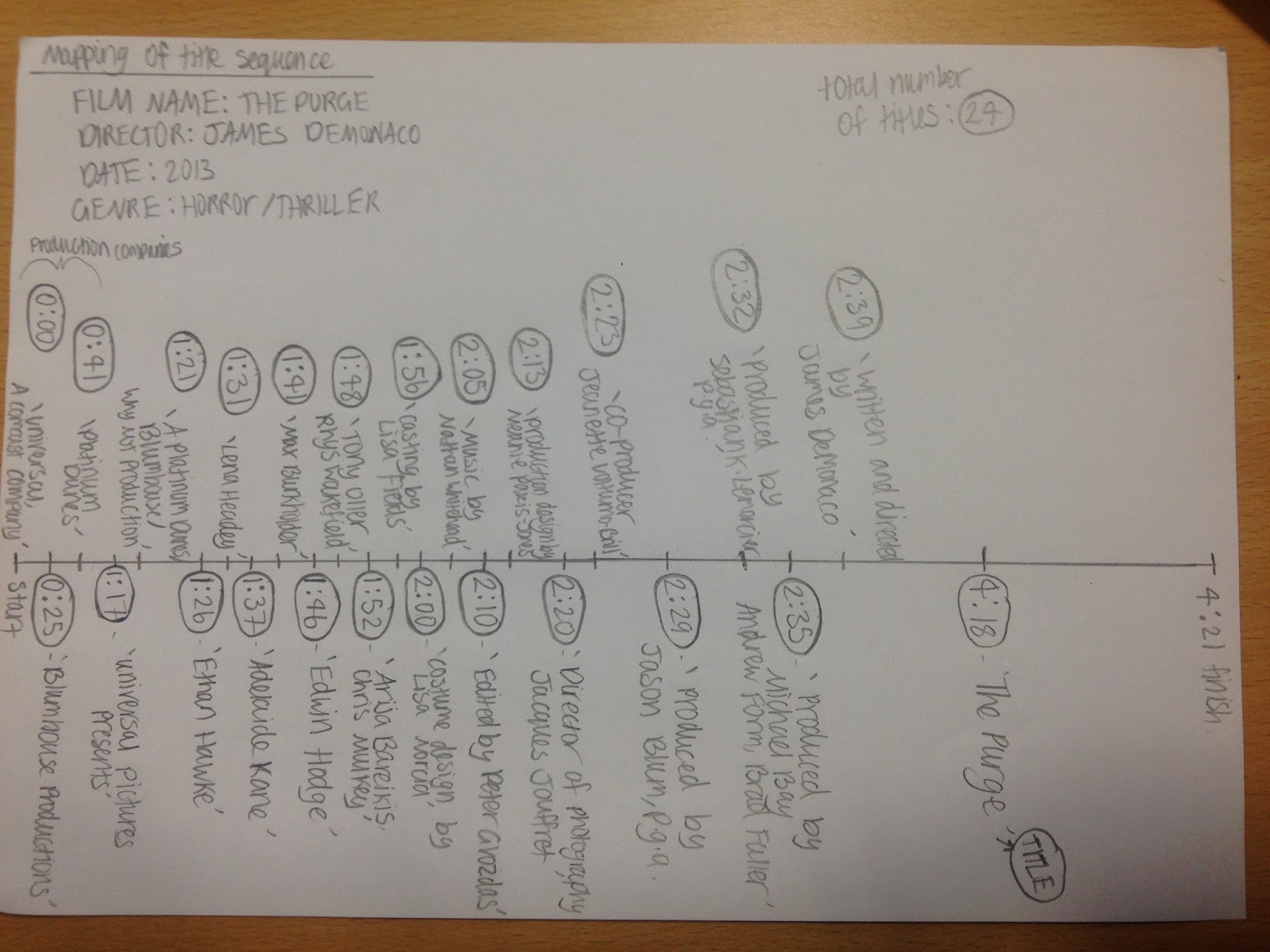
Mapping of Title Sequences
Mapping of title sequences
From mapping out three title sequences, I have learnt that there are around 23 - 15 titles which appear in the majority of sequences. We will probably make ours have less than this amount because we will only include the most important titles e.g. the director and the top cast members. We may therefore have about 15 titles in our sequence and will include both pre and post production members, actors, and the title of the film. This is the order that we have created:
- 2-3 production companies
- 2-3 main actors
- The film title
- 5-10 pre production workers
- DIRECTOR
This may be changed around a bit because we haven't completed the task as of yet. We may choose to add a few more titles, or move the film name to the end of the opening sequence, depending on how the production turns out. We may change this whilst in the story boarding process but we would like the rest of the titles to stay in their order. We must still work out which jobs we would like to be included in our opening sequence. These are some common ones which usually appear from the mapped sequences I have looked at:
- Casting
- Music
- Editor
- Director of Photography
- Producer
- Production Designer
- Screenplay
- Based on ___
- Written and Directed
- Director
There are other jobs which appeared in the sequences that depended on the genre of the film. For example, Coraline is an animation, so it is the only sequence out of the three that included titles such as 'lead animators' and 'art directors'. As we are doing a thriller movie, we will most likely just have to include the roles that are in the majority of title sequences and won't have to include anything that specific.
Wednesday, 4 November 2015
Subscribe to:
Posts (Atom)